From the bank's first email to the registered deed coming back — every case, every chain of title, every document in someone's hands, tracked and timed on one platform.
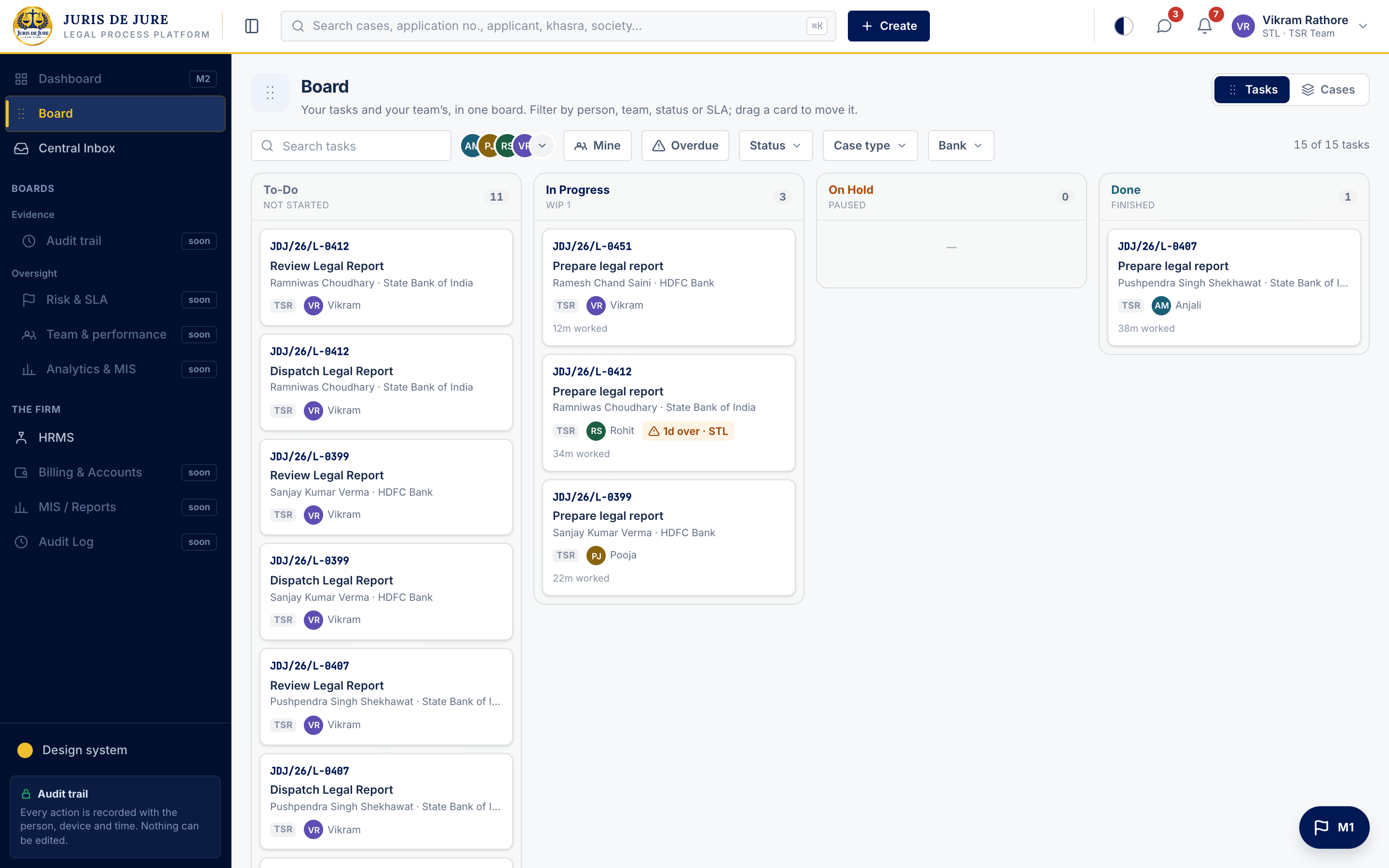
Instructions arrive by email and WhatsApp. Work is tracked in spreadsheets and in people's heads. Originals move hand to hand. So when the bank asks why a file is late, there is no single answer — and the delay lands on the firm.
Every bank mailbox and WhatsApp number sits in one inbox. The platform reads the instruction, pulls the application number, applicant and property, and raises the case — routed to the right desk before anyone has typed a word.
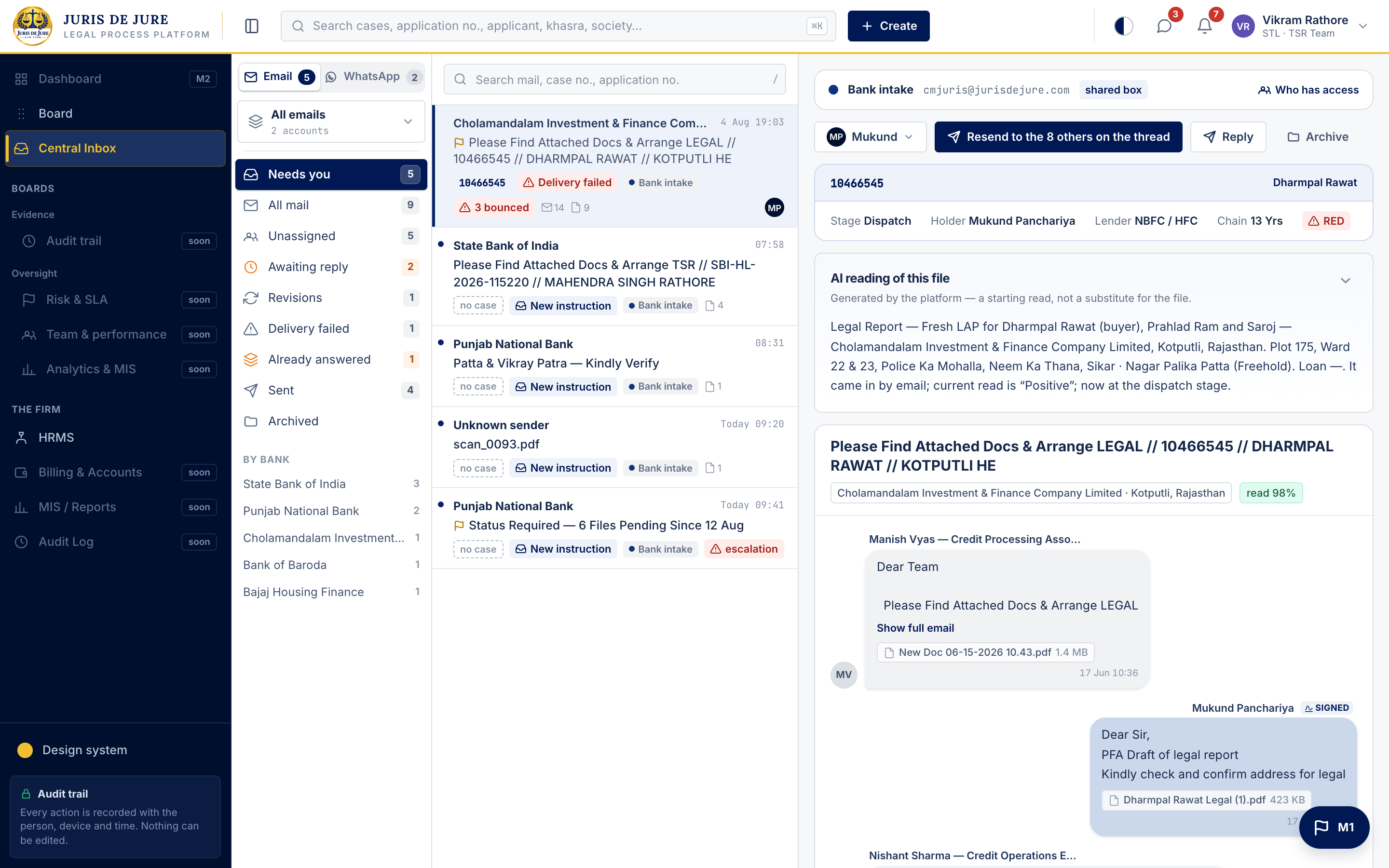
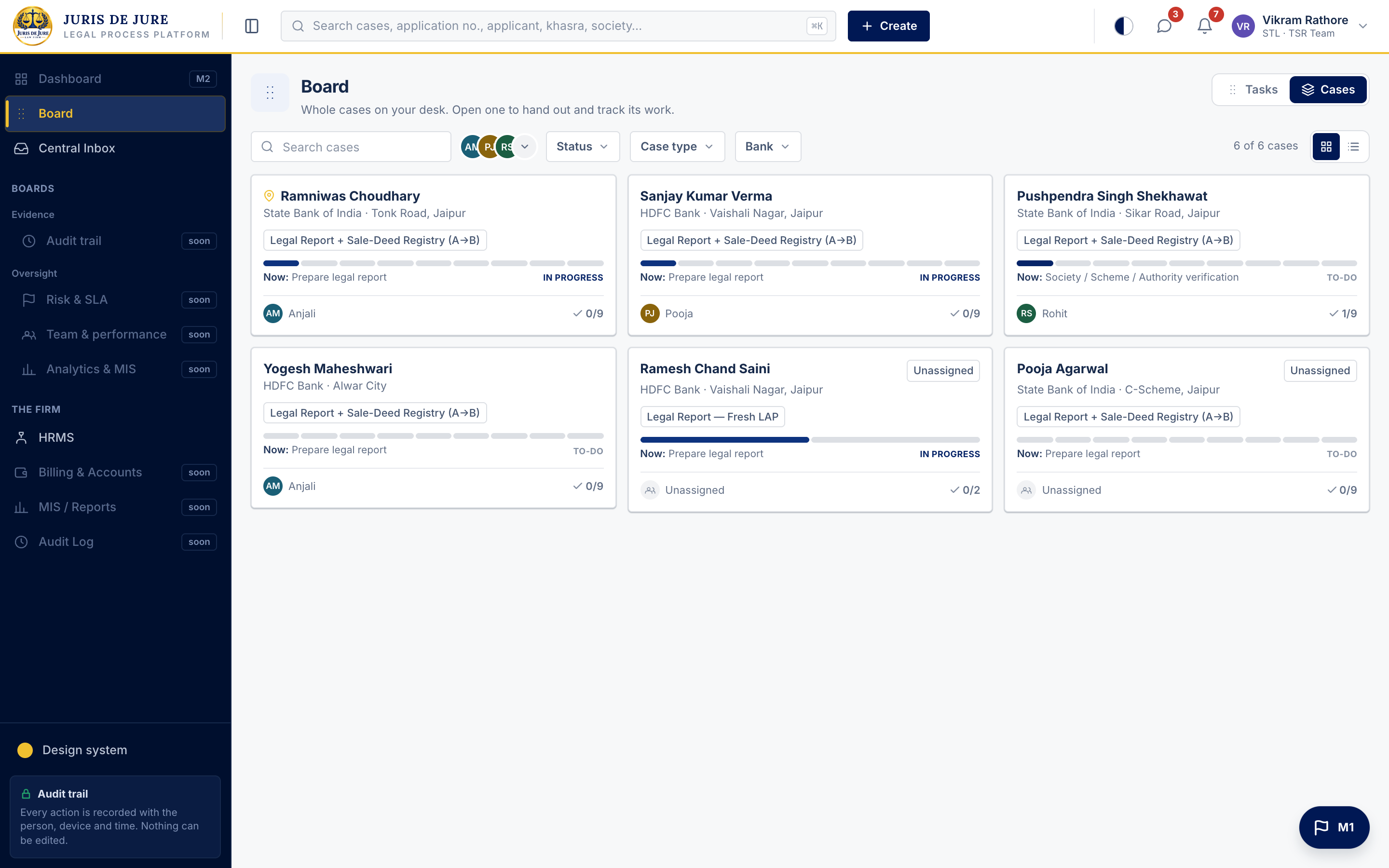
The whole firm's work on a single board — filter to a person, a team, a bank, or what is overdue. Each step unlocks the next, one task is in progress at a time, and a hand-off is a record, not a sticky note.
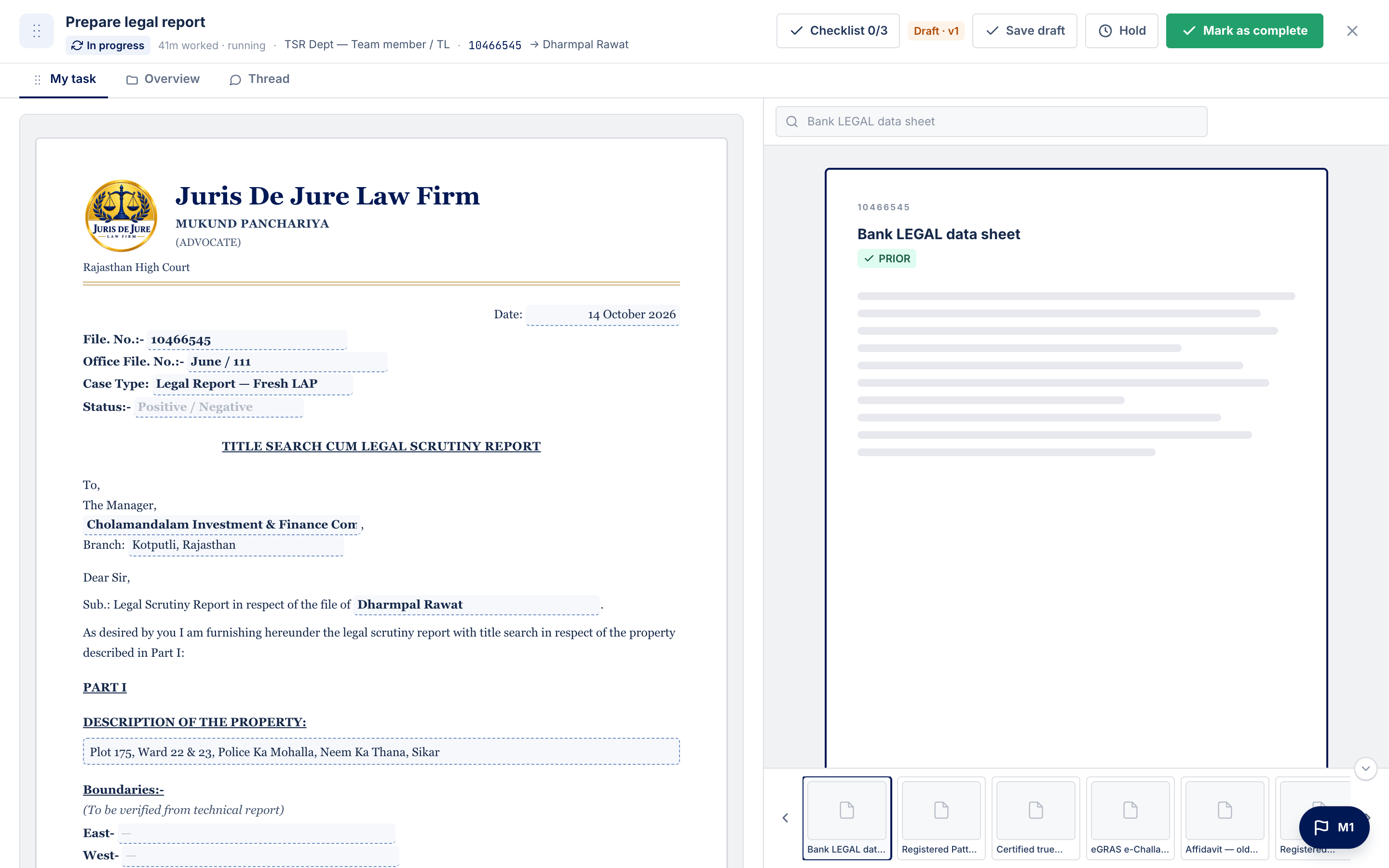
The Title Search cum Legal Scrutiny Report drafts on the firm's own letterhead, pre-filled from the file. Then it is reviewed, e-signed and dispatched — with every version kept, exactly as it went out.
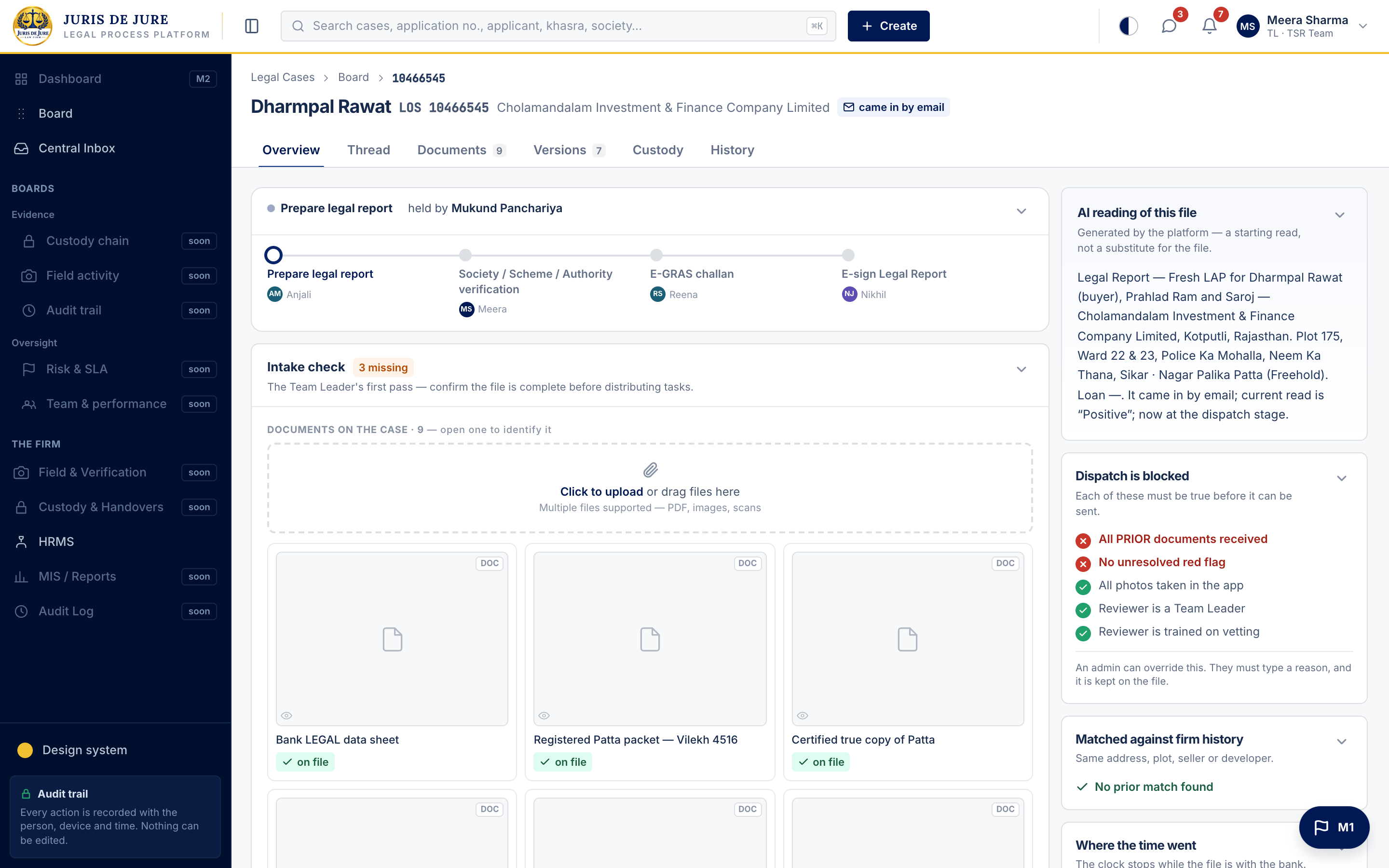
One page holds the whole case — the stage it is at, the documents on it, an AI reading to orient whoever opens it, the firm-history matches, and a dispatch gate that will not open until every condition is true.
Every case on a desk, by stage, with an SLA clock that pauses while a file sits with the bank. The firm's real turnaround is visible — and the delay sits exactly where it belongs.
Every action is stamped with the person, the device and the time. Nothing can be edited or removed after the fact.
A stay order, a broken chain, a disputed layout — once found, it can't be dismissed or hidden. It travels with the file to the bank.
eGRAS and e-sign sit behind their own wall, apart from the case team — so no one signs their own work through.
A bank email or WhatsApp arrives in the shared inbox.
The platform reads it and assigns the right desk, automatically.
Title search → verification → review → eGRAS → e-sign.
Reviewed, signed and delivered — every version kept.
Custody tracked by OTP until the file is safely closed.
Intake, drafting and hand-offs that used to be manual now happen in a click — so lawyers spend their time on the law, not the logistics.
The timeline, the SLA clock and the audit trail let the firm show exactly where a file stands — and whose delay it is.
An immutable record of who did what, and when, on every case — built for the scrutiny that bank legal work invites.
Not a generic workflow tool — a platform shaped by the real pressures of title search, registry and mortgage execution.

Juris De Jure is a Jaipur-based law firm that has spent years doing bank and NBFC legal-process work — title search, legal scrutiny reports, sale-deed registry and mortgage execution — at volume, under the deadlines and scrutiny the work demands.
We built this platform for ourselves first: to open every bank file the moment it arrives, to keep every document accountable from the first email to the registered deed coming back, and to never again lose a day to a file no one could find. It worked — so we are opening it to firms that carry the same load.
Book a walkthrough on a real case, or send a note — we'll show you how Juris De Jure would run your bank work, end to end.